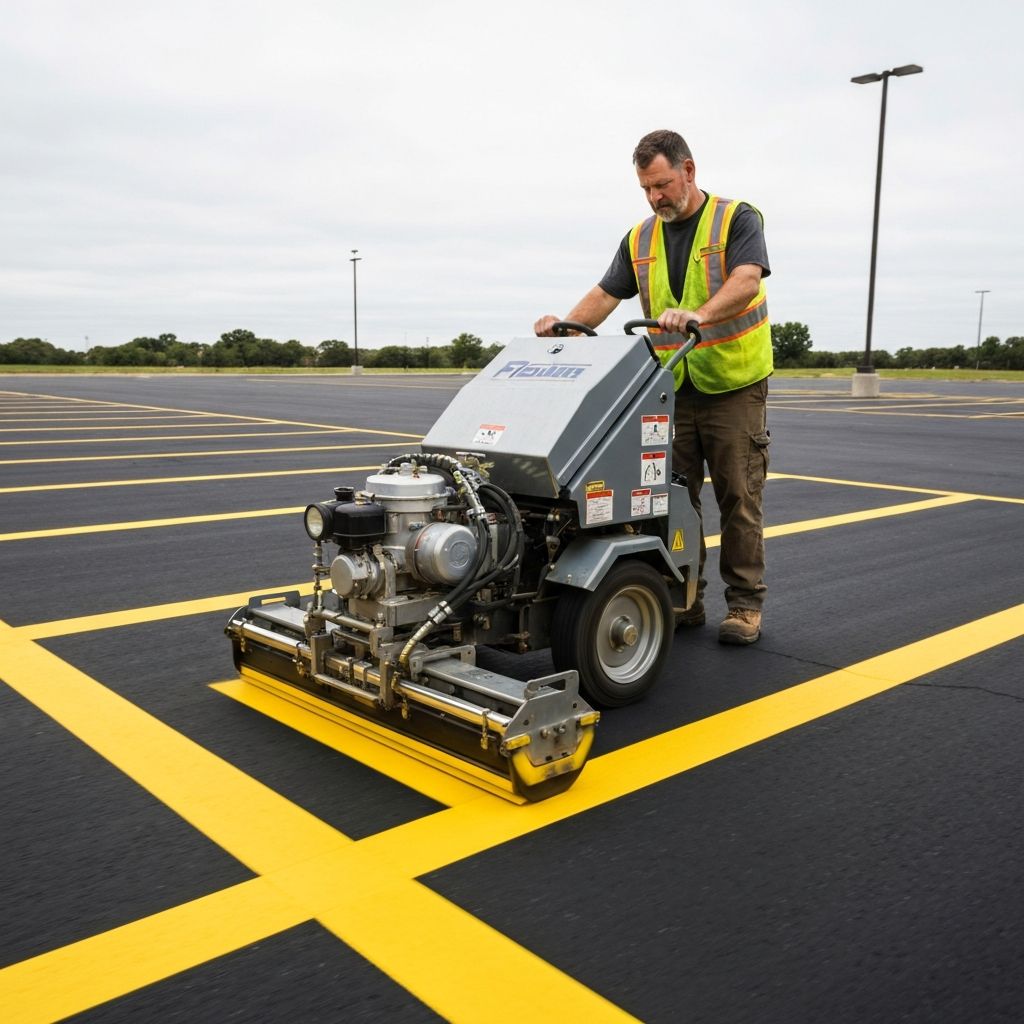
The Omaha metro is one of the faster-growing commercial development corridors in the Midwest. New retail centers, medical offices, mixed-use developments, and industrial facilities are going up across West Omaha, Gretna, Papillion, and the Highway 370 corridor — and every one of them needs a parking lot striped before it can open. Striping a brand-new commercial lot is a different job than re-striping an existing one, and developers and general contractors who treat it the same way run into avoidable problems. This guide covers what's actually different about new construction striping in Omaha: curing timelines, ADA layout from scratch, scheduling around the build, and the Nebraska-specific factors that affect a first stripe on fresh asphalt.
Fresh Asphalt Needs to Cure Before You Stripe
The most common mistake on new construction is striping too early. Freshly laid asphalt contains oils that need time to rise to the surface and dissipate. Striping over asphalt that hasn't cured traps those oils under the paint and compromises adhesion, so the markings start failing prematurely — which on a brand-new lot is both embarrassing and expensive to redo. The general standard is to wait approximately 30 days after paving before applying permanent striping, though exact timing depends on temperature and conditions. Omaha summer heat can shorten the window slightly, while cooler spring and fall paving may require the full 30 days or more. For developers working against an opening date, this curing window has to be built into the construction schedule from the start. A common workaround for tight timelines is temporary striping immediately after paving, followed by permanent striping once the asphalt has cured — a professional striping contractor can advise whether that makes sense for your project.
ADA Layout on a New Lot Is a Design Decision
On an existing lot, ADA striping is largely about restoring what's already there. On new construction, you're designing the accessible parking from scratch, and getting it right the first time is far cheaper than correcting it after an inspection or complaint. The 2010 ADA Standards for Accessible Design dictate the requirements. The number of accessible spaces scales with total lot size: a 25-space lot requires one, a 100-space lot requires four, a 200-space lot requires six. Each accessible space requires a minimum 96-inch stall width, an adjacent access aisle (60 inches minimum, 96 inches for van-accessible spaces), the International Symbol of Accessibility, and signage at the correct mounting height. At least one in every six accessible spaces must be van-accessible, and accessible spaces must sit on the shortest accessible route to the entrance — a site-design consideration, not just a striping one. Getting this right from the start, as part of the original lot layout, costs nothing extra and eliminates the risk of correcting it later.
Omaha Code and Compliance on New Builds
New commercial construction in Omaha must satisfy multiple layers of requirements for parking lot markings. Federal MUTCD standards govern line widths, colors, and stencil placement. The City of Omaha Municipal Code Chapter 55 addresses commercial parking lot requirements including layout and accessibility. And the 2010 ADA Standards govern accessible parking specifically. On new construction these are typically reviewed as part of permitting and inspection, meaning errors get caught and must be corrected before occupancy. A layout that fails inspection delays your certificate of occupancy, which on a commercial development is a costly delay — an argument for using a striping contractor who understands new construction and local code rather than handing the stripe to the cheapest available crew.
Coordinating Striping With the Construction Schedule
Striping is one of the last trades on site, which makes it vulnerable to schedule compression when earlier phases run long. Paving and striping are sequential and both weather-dependent. In Omaha this matters: a late-fall paving job can run into trouble, because if the asphalt is laid too late in the season the curing window may push into temperatures too cold for proper striping, forcing the permanent stripe into the following spring. Communicate the opening date to your striping contractor early — a professional can work backward from the opening to tell you the latest acceptable paving date that still allows proper curing and striping. And build in weather buffer: striping is fast, with most lots completed in a single day, but it can't happen on wet pavement or in a hard freeze, so a few days of buffer before opening protects against a rain delay becoming an unstriped lot on opening day.
What New Construction Striping Costs
New construction striping is priced similarly to re-striping, with the advantage that a fresh lot requires no blackout of old lines. Typical Omaha-market pricing applies: standard parking lines at $0.20 to $0.35 per linear foot, complete ADA stalls at $175 to $325 each, fire lane striping at $2.50 to $4.50 per linear foot, and directional arrows at $35 to $75 each. For a full commercial lot, the total depends on size and the number of accessible spaces, fire lanes, and directional markings the layout requires. A professional contractor provides an itemized quote based on the site plan, which is useful for developers building striping into a project budget.
Getting New Construction Striping Done in Omaha
For developers and general contractors working on new commercial construction in the Omaha metro, the right striping partner understands curing timelines, designs ADA-compliant layouts from scratch, coordinates with the construction schedule, and knows local code. PrecisionLine Striping provides new construction and commercial parking lot striping across the Omaha metro — Bellevue, Papillion, La Vista, Elkhorn, Gretna, and Council Bluffs — handling new lot layout and design, ADA-compliant accessible parking, fire lane striping, and the full range of commercial markings to MUTCD and Omaha Municipal Code standards, coordinated around your construction schedule. For new development projects, getting the striping contractor involved during scheduling rather than at the last minute is the difference between a smooth opening and a scramble. Learn more about our parking lot striping in Omaha and get a free estimate based on your site plan before you finalize the construction schedule.
Need Parking Lot Striping?
Get fast, professional striping services today.
Related Articles

ADA Compliance Parking Lot Guide (2025)
Learn ADA parking lot striping requirements, dimensions, and compliance rules to avoid fines.

Parking Lot Striping Cost Guide (2025)
How much does parking lot striping cost? Learn pricing factors and average costs.

Signs Your Parking Lot Needs New Striping
Faded parking lot lines? Learn when it's time to restripe your parking lot.